

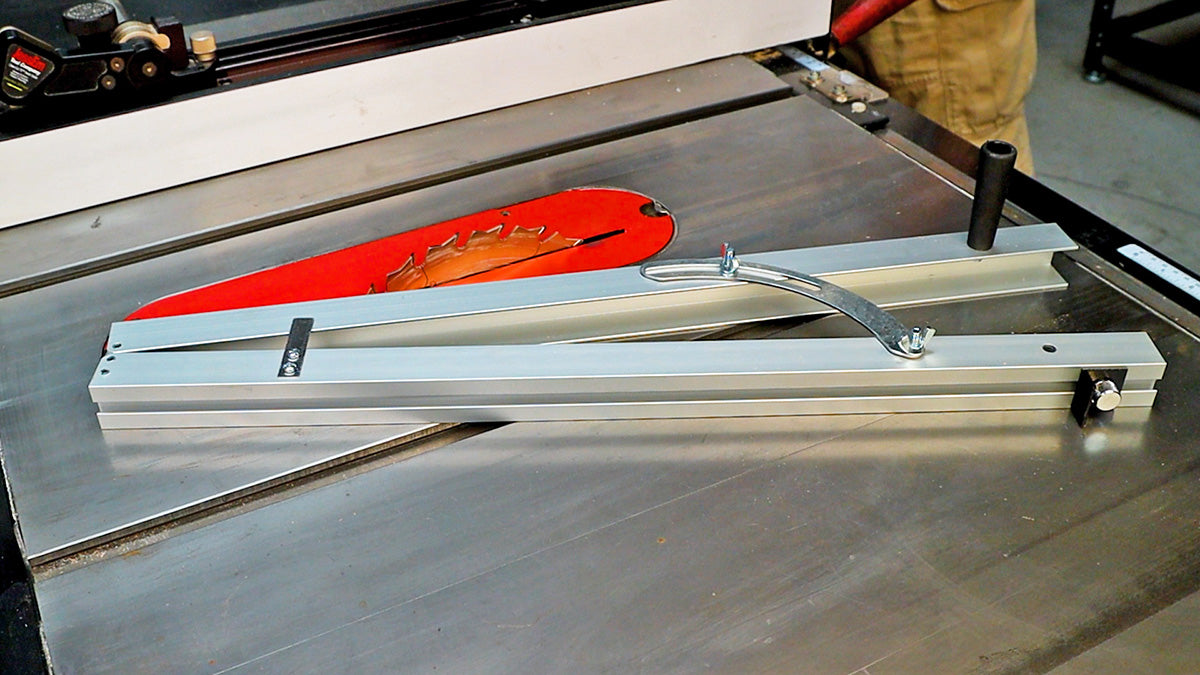
One of the first accessories that many woodworkers purchase for the table saw is a tapering jig. It’s used to safely make long tapering cuts at the table saw for things like table legs or angled panel cuts. The Infinity tapering jig is made from extruded aluminum for stiffness and lightness in use.

It also includes a gauge to repeatedly set to the proper angle. You can choose either 0-15° on one side of the scale or select a pitch angle, with 0-3" of angle per linear foot, settable in quarter-inch increments.

It features a tall handle for safe operation...

... and a movable stop block to help steady your workpiece through the cut.

Once you determine your proper angle,set the arched locking bar into place and position your table saw fence. Hold the jig against your fence, place the workpiece against the stop block and guide it through your saw blade. We set our jig to a ten-degree angle and made our cuts.
It’s just that easy and the results are repeatable.

The Infinity Tools table saw taper jig is a must-have for any woodworker’s shop.
How to Calculate a Taper
Most taper jigs can be set by angle or by inches of taper per foot. To find either one, you need two numbers: how much material comes off (the offset) and the length of the taper.
- Taper per foot = offset ÷ taper length in feet.
- Angle = the arctangent of (offset ÷ taper length). Many calculators and phone apps have a "tan⁻¹" button.
Example: a table leg tapers from 1-3/4" to 1" on one face over the bottom 24". The offset is 3/4" and the length is 2 ft, so the taper is 3/8" per foot, or about 1.8°.
Setting Up a Taper Cut Step by Step
- Mark the taper on the workpiece: a line where the taper starts and the finished width at the end.
- Set the jig to your angle or taper per foot, and lock it.
- Place the workpiece on the jig against the stop block, with the taper line facing the blade.
- Set the fence. With the jig against the fence, slide the fence until the blade lines up with your taper line at both the start and end marks.
- Make a test cut on scrap of the same size, then check it against your layout.
- Cut. Keep the jig tight to the fence and push it past the blade with the handle, keeping your hands well away from the blade.
Tapering Table Legs on Two or Four Sides
- Two-sided taper (the classic look on the inside faces of table legs): cut one face, rotate the leg 90° so the uncut inside face is toward the blade, and cut again at the same setting.
- Four-sided taper: cut two adjacent faces as above. For the remaining two faces, the already-tapered face rides against the jig, so on a simple single-angle jig you'll typically need to double the setting. Test on scrap first.
- Mark which faces get tapered on every leg before you start, so all four legs match.
Build a Simple Sled-Style Taper Jig
For long or one-off tapers, you can also make a dedicated sled:
- Start with a flat piece of 1/2" or 3/4" plywood a few inches longer and wider than your workpiece. One edge must be perfectly straight; it rides against the fence.
- Draw the taper line on the workpiece and lay it on the sled so the line is exactly on the sled's straight edge.
- Screw cleats against the back edge and end of the workpiece to hold it in that position.
- Add toggle clamps to hold the workpiece down, and a handle at the back for pushing.
- Set the fence so the blade just trims the sled's edge on the first pass. After that, the sled's edge shows exactly where the blade will cut.
Taper Cutting Safety
- Never cut a taper freehand or against the fence alone; always use a jig or sled.
- Keep the blade guard and riving knife in place when your saw and jig allow it.
- Support long workpieces at the outfeed side.
- Let the offcut fall away freely, and turn off the saw before reaching for it.
Taper Jig FAQ
What angle should table legs be tapered?
Most furniture legs taper between 1° and 3° per face, often removing about a third of the leg's thickness at the foot. Lay out a full-size drawing to see what looks right for your project.
Can I cut a taper on a router table or bandsaw?
Yes. Rough-cut on the bandsaw and clean up with a hand plane, or use a template and flush trim bit at the router table. A table saw jig is the fastest way to make repeatable tapers.
Do taper jigs work on any table saw?
A fence-riding taper jig like ours works on any table saw with a straight rip fence.
Shop the Infinity Tools table saw taper jig and the MicroJig MicroDial tapering jig.


